Wailee Ming
Deception PointWailee Ming, a UCLA paleontologist whose expertise helps interpret the fossils inside the meteorite, becomes both a witness to a second anomaly at the extraction pit and a casualty of the expedition. His death, followed by Lawrence Ekstrom’s order to conceal it until after the press conference, exposes the human cost of protecting NASA’s public announcement.
Identity and Expertise
Ming introduces himself to Rachel Sexton as chairman of paleontology at UCLA. He has joined the expedition as one of the President’s civilian recruits and offers to explain the fossils. His manner is formal and self-conscious: he wears a bow tie beneath a camel-hair coat even in the remote setting, and repeatedly touches the tie while discussing his work.
His specialty is extinct Arthropoda and Mygalomorphae. Rather than treating the enormous specimens as categorically alien, Ming explains how they might fit terrestrial classification: if found on Earth, the species would belong to the order Isopoda, in a class that includes about two thousand species of lice. He points to physical traits—a flattened body, seven pairs of legs, and a reproductive pouch resembling those of wood lice, pill bugs, beach hoppers, sow bugs, and gribbles—to support that comparison. His explanation makes an extraordinary fossil intelligible through familiar anatomy, even as the scale of the specimens unsettles that familiarity.
Ming also interprets the concentration of fossils in the meteorite. Paleolithic records, he explains, often preserve organisms in large groups because mudslides can trap whole nests or communities. The x-ray cross section shows dozens of specimens, including one estimated at roughly two feet long. Ming proposes that reduced gravity on the organism’s home planet could have allowed insects to grow much larger than Earth’s gravity permits. His role is therefore not simply to identify a fossil: he supplies a plausible framework for understanding its anatomy, grouping, and size.
A Scientist in the Public Spotlight
Ming’s technical standing is intertwined with the expedition’s media event. In his private work area, he anticipates becoming the world’s most famous paleontologist and hopes Michael Tolland’s documentary will include his comments. The coming press conference gives the discovery a public audience, and Ming imagines his own scientific contribution gaining recognition through it.
That expectation contrasts with the way Corky Marlinson and Tolland react when he first joins Rachel. Their animated discussion falls quiet, and Corky needles Ming’s careful presentation. The exchange reveals a difference in style rather than a dispute over Ming’s expertise: he proceeds through taxonomy and anatomical comparison, while Corky emphasizes the startling possibility that the fossils come from another planet. Ming insists on classification, not spectacle, even though the spectacle is what gives the discovery its political and public force.
The Anomaly at the Extraction Pit
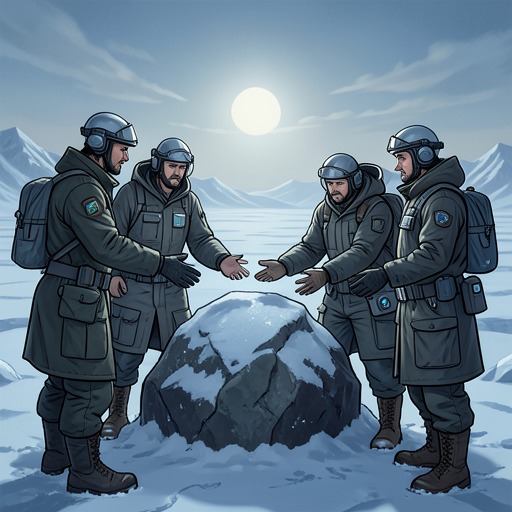
After the lights in the dome go out, Ming notices something unusual in the water-filled extraction pit. At first he wonders whether he is seeing a reflection or an optical illusion. He steps beyond the pylons, crouches at the edge, and observes the water, which lies four feet below ice level. Once he recognizes that the phenomenon is real, he starts toward the press area to report it, then turns back as he realizes what it may mean.
Ming returns to the pit to investigate more closely. Lying on his stomach beside the opening, he reaches toward the water with a beaker, shifting closer when his arm cannot reach. He manages to draw a sample. The scene establishes his attention to evidence through a concrete act of observation and collection: rather than leave an uncertain sighting unexplained, he tries to obtain material that could be examined.
The investigation ends before Ming can report what he has seen. A tiny metal fragment strikes his right eye, and he falls into the extraction pit. The GPR printout later reveals a humanoid form floating head down in the shaft, with the outline of a dense camel-hair coat around it. That distinctive clothing identifies the body as Ming’s. His earlier choice to investigate the anomaly thus leads directly to his death, while the printout converts the concealed accident into evidence visible to the surviving investigators.
Death and Concealment
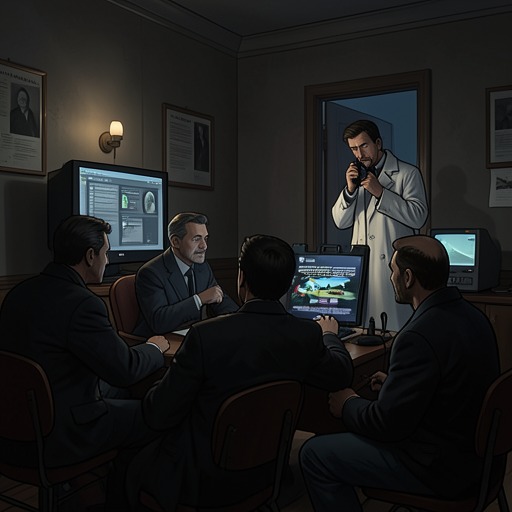
When technicians report that Ming’s body has surfaced, they tell Ekstrom that Ming has been dead for about an hour. Their account is that he fell into the pit, sank, and later floated back up. Ekstrom first reacts with disbelief and asks who knows; when told that only the two technicians do, he directs them to stow the body and say nothing.
Ekstrom presents the concealment as a decision about timing and institutional consequences. With the press conference about an hour away, he argues that announcing a fatal accident would overshadow the discovery and damage morale. He characterizes Ming’s fall as a careless mistake and says NASA should not pay for it at the moment of its public triumph. The technician understands that the instruction means hiding the body, and agrees to do so. Ming’s death is therefore not immediately acknowledged to the expedition or the public; it is deliberately withheld to preserve the announcement.
The concealment later sharpens the danger surrounding the discovery. Rachel Sexton tells the White House that Norah Mangor was killed over the matter and that Ming is also dead, urging a warning. The response does not validate her warning: she is rebuked for making allegations over an unsecured line, reminded that scientists have recorded endorsements of the meteorite data, and told she is relieved of her post. In this exchange, Ming’s death is one of the facts Rachel invokes as she tries to alert others, while the official response protects the public account rather than addressing his fate.
Narrative Role
Ming’s character joins scientific explanation to a plot about the control of evidence. His classification of the fossils depends on observable structure and comparison; at the pit, he applies that same investigative impulse to an unexpected sight. The contrast is consequential: the scientist who helps translate the meteorite into an intelligible discovery becomes a witness to evidence that cannot be allowed to enter the planned public narrative.
His death also marks a shift in the expedition’s stakes. Before the accident, the central tension around Ming is how to interpret extraordinary fossils and who will explain them to the world. Afterward, the missing body, its recovery in the GPR image, and Ekstrom’s concealment order make institutional choices part of the scientific crisis. Ming does not live to report his observation or see the press conference; the evidence associated with him survives instead, linking his careful inquiry to the broader struggle over what the expedition is permitted to reveal.